



AMD Ryzen CPU Processors – High Performance Computing Solutions
Abstract
AMD Ryzen processors deliver industry-leading performance for gaming, workstation, and enterprise computing applications. Built on advanced Zen microarchitecture and manufactured using cutting-edge process nodes, Ryzen CPUs provide exceptional multi-threaded performance, power efficiency, and scalability across diverse computing workloads. This comprehensive guide examines Ryzen architecture fundamentals, technical specifications, performance benchmarks, and procurement considerations for B2B buyers seeking high-performance computing solutions. From entry-level Ryzen 3 processors to flagship Threadripper workstation platforms, AMD’s product ecosystem addresses requirements ranging from cost-sensitive deployments to mission-critical enterprise infrastructure. Understanding core technology differentiators, platform compatibility requirements, and total cost of ownership models enables informed purchasing decisions for organizational computing investments.
AMD Ryzen Architecture and Core Technology
Zen Microarchitecture Evolution
AMD’s Zen microarchitecture represents a fundamental redesign that restored the company’s competitive position in high-performance computing markets. The original Zen architecture (2017) delivered 52% IPC (instructions per cycle) improvement over previous AMD designs through enhanced branch prediction, larger instruction windows, and improved cache subsystems. Zen+ refinement (12nm process) introduced precision boost algorithms and memory controller optimizations that increased effective clock speeds by 3-5%.
Zen 2 architecture (7nm TSMC process) transitioned to chiplet-based design, separating compute cores from I/O functionality. This approach enabled higher core counts within thermal envelopes while improving manufacturing yields. The architecture achieved 15% IPC gains through doubled floating-point execution width and enhanced load/store bandwidth. Zen 3 (enhanced 7nm) restructured cache topology, providing each 8-core CCX (Core Complex) with unified 32MB L3 cache access, reducing inter-core latency by up to 30% for workloads with large working sets.
Current-generation Zen 4 architecture (5nm process) delivers 13% single-thread performance improvement and introduces support for DDR5 memory, PCIe 5.0 connectivity, and integrated RDNA 2 graphics. The transition to 5nm process technology enables higher sustained boost frequencies (up to 5.7GHz) while maintaining competitive TDP ratings. For B2B deployments, Zen 4’s AVX-512 instruction support accelerates scientific computing, financial modeling, and media encoding workloads by 10-30% compared to Zen 3 equivalents.
Multi-Core Design and Threading Technology
AMD implements Simultaneous Multithreading (SMT) across all Ryzen processor tiers, enabling each physical core to execute two instruction threads concurrently. This approach maximizes execution unit utilization during memory-bound operations, improving aggregate throughput for virtualization, compilation, and rendering workloads by 15-40% compared to non-SMT configurations.
Ryzen processors employ a three-level cache hierarchy optimized for multi-threaded performance. Each core contains dedicated 32KB L1 instruction and data caches, plus 512KB L2 cache. L3 cache allocation varies by product tier: mainstream Ryzen processors provide 32MB shared L3 per 8-core CCX, while Ryzen 9 flagship models feature up to 64MB total L3 capacity. The Infinity Fabric interconnect maintains cache coherency across CCX boundaries with sub-20ns latency, critical for database operations and in-memory analytics.
Cache prefetching algorithms predict memory access patterns, reducing effective DRAM latency. For workstation applications processing large datasets (CAD rendering, video editing), proper cache utilization reduces reliance on slower system memory, maintaining performance consistency during sustained workloads. B2B buyers should correlate L3 cache capacity with application working set sizes—financial modeling and EDA (Electronic Design Automation) tools particularly benefit from larger cache allocations.
Product Line Specifications and Performance Tiers
Ryzen 3/5/7/9 Series Differentiation
AMD segments consumer and professional Ryzen processors into four primary tiers, each targeting distinct price-performance requirements. Ryzen 3 processors (4-6 cores, 8-12 threads) address entry-level workstations and general business computing at $99-$149 price points. These SKUs provide sufficient performance for office productivity, web applications, and light content creation while maintaining sub-65W TDP ratings compatible with small-form-factor systems.
Ryzen 5 processors (6-8 cores, 12-16 threads) represent the volume segment for mainstream workstations. Models like the Ryzen 5 7600X (6-core, 4.7GHz base, 5.3GHz boost) deliver balanced single-thread and multi-thread performance suitable for engineering workstations, software development environments, and mid-tier content creation. Pricing between $199-$299 provides competitive total cost of ownership for departmental deployments.
Ryzen 7 processors (8 cores, 16 threads) target professional workstations requiring sustained multi-threaded performance. The Ryzen 7 7700X operates at 4.5GHz base frequency with 5.4GHz boost capability, delivering performance comparable to previous-generation 12-core processors in properly parallelized workloads. These SKUs excel in 3D rendering, video encoding, and multi-virtual machine environments at $299-$399 price positioning.
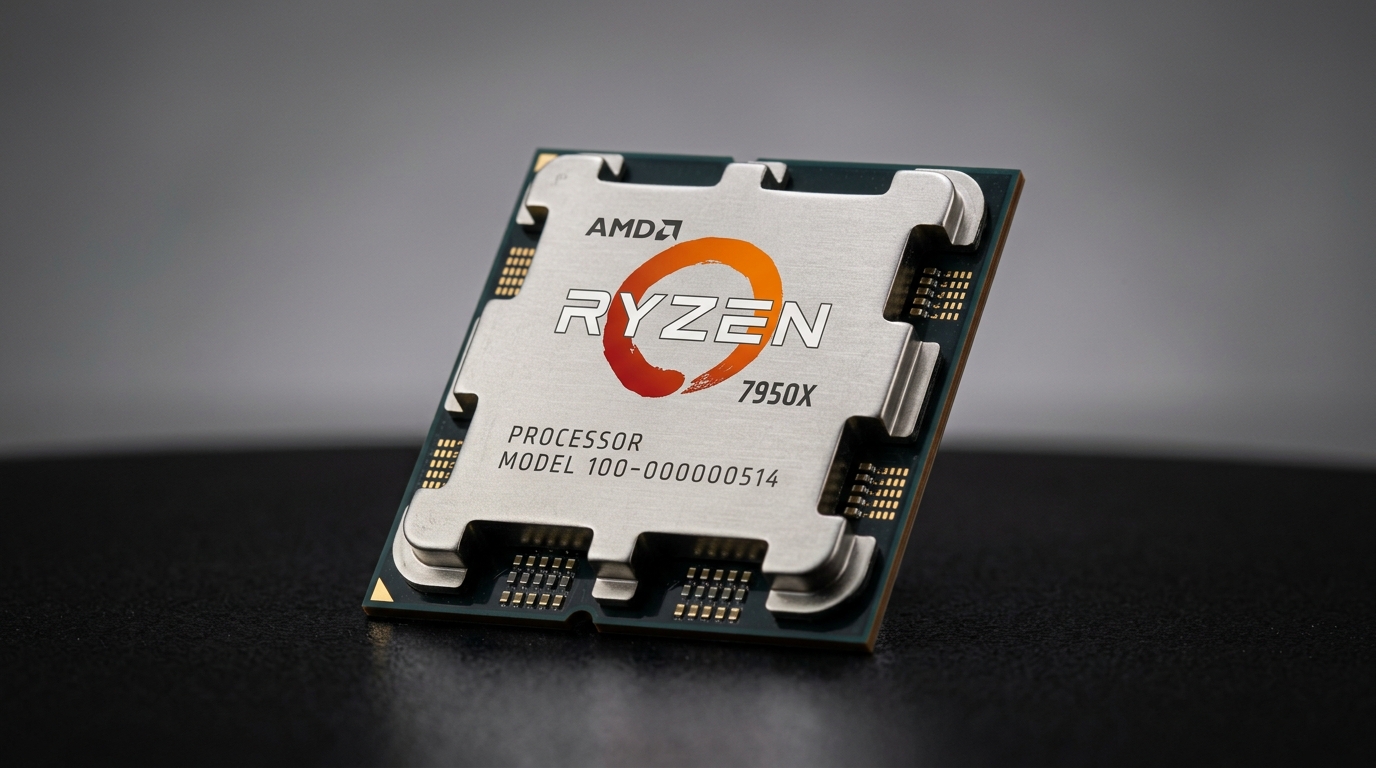
Ryzen 9 flagship processors (12-16 cores, 24-32 threads) address high-end workstation and enthusiast requirements. The Ryzen 9 7950X (16-core, 4.5GHz base, 5.7GHz boost, 170W TDP) provides workstation-class performance for demanding applications including simulation, compilation, and professional video production. At $549-$699, these processors offer superior price-to-performance versus competing HEDT (High-End Desktop) platforms requiring expensive chipsets and memory configurations.
Threadripper and EPYC for Workstation/Server Applications
AMD Threadripper processors extend Ryzen architecture to extreme core counts for specialized workstation applications. Threadripper PRO 5000WX series processors scale from 12 to 64 cores (24-128 threads), providing up to 128 PCIe 4.0 lanes and 8-channel DDR4 memory support. These configurations address workloads requiring massive I/O bandwidth: real-time video editing with multiple 8K streams, large-scale CAD assemblies, and computational fluid dynamics simulations.
The Threadripper PRO platform includes ECC memory support, essential for financial modeling and scientific computing where data integrity cannot be compromised. ISV (Independent Software Vendor) certifications from Autodesk, Adobe, Dassault Systèmes, and Siemens validate platform stability for mission-critical professional applications. For B2B procurement, Threadripper PRO systems provide workstation performance approaching dual-socket server platforms while maintaining single-socket simplicity and lower infrastructure costs.
EPYC server processors leverage identical Zen architecture in configurations optimized for multi-socket scalability and enterprise features. EPYC 9004 series (Zen 4) processors deliver up to 96 cores per socket with 12-channel DDR5 memory and 128 PCIe 5.0 lanes. While positioned for datacenter deployment, single-socket EPYC configurations serve specialized workstation roles requiring maximum memory capacity (up to 6TB per socket) or I/O connectivity for storage arrays and GPU compute clusters.
Ryzen Product Comparison Matrix
| Model Series | Core/Thread Count | Base/Boost Clock | TDP | Total Cache | Price Segment |
|---|---|---|---|---|---|
| Ryzen 3 7300X | 4C/8T | 4.5/5.0 GHz | 65W | 20MB | $99-$149 |
| Ryzen 5 7600X | 6C/12T | 4.7/5.3 GHz | 105W | 38MB | $199-$299 |
| Ryzen 7 7700X | 8C/16T | 4.5/5.4 GHz | 105W | 40MB | $299-$399 |
| Ryzen 9 7950X | 16C/32T | 4.5/5.7 GHz | 170W | 80MB | $549-$699 |
| Threadripper PRO 5975WX | 32C/64T | 3.6/4.5 GHz | 280W | 140MB | $2,399-$2,999 |
| Threadripper PRO 5995WX | 64C/128T | 2.7/4.5 GHz | 280W | 288MB | $6,499-$6,999 |
Technical Standards and Platform Compatibility
Socket Standards and Chipset Requirements
AMD Ryzen processors utilize two primary socket standards defining platform longevity and upgrade flexibility. The AM4 socket (1331-pin PGA) supported four generations of Ryzen processors (2017-2022), providing unprecedented platform stability for B2B deployments. Organizations could upgrade from first-generation Ryzen 1000 series to Ryzen 5000 series processors using existing motherboard infrastructure (with BIOS updates), extending hardware refresh cycles and reducing total cost of ownership.
The AM5 socket (1718-pin LGA) introduced with Ryzen 7000 series represents AMD’s current platform foundation. The LGA (Land Grid Array) design moves socket pins to the motherboard, reducing CPU handling damage risk during installation—a meaningful consideration for high-volume system integrators. AMD committed to AM5 socket support through 2025+, ensuring multi-generation processor compatibility for organizations planning extended deployment lifecycles.
Chipset selection determines platform capabilities and expansion options. A-series chipsets (A620) provide basic functionality for cost-sensitive deployments with limited PCIe lane allocation and reduced USB connectivity. B-series chipsets (B650/B650E) balance features and cost, offering sufficient PCIe lanes and USB ports for mainstream workstations. The "E" designation indicates PCIe 5.0 support for graphics and primary NVMe storage. X-series chipsets (X670/X670E) maximize expansion capability with additional PCIe lanes, USB 4.0 support, and enhanced overclocking features for high-performance workstation builds.
Memory and PCIe Specifications
Ryzen 7000 series processors implement dual-channel DDR5 memory controllers supporting official specifications up to DDR5-5200. Memory subsystem performance directly impacts application responsiveness—financial modeling, database operations, and scientific computing demonstrate 10-15% performance improvements migrating from DDR4-3200 to DDR5-5200 configurations. For workstation deployments, 32GB (2x16GB) represents the minimum recommended configuration, while content creation and virtualization workloads benefit from 64-128GB capacities.
AMD EXPO (Extended Profiles for Overclocking) technology provides validated memory overclocking profiles, enabling DDR5-6000+ operation with compatible modules. While beneficial for performance-critical applications, B2B buyers should weigh stability requirements against marginal performance gains—mission-critical systems typically operate at JEDEC-standard memory speeds to maximize reliability.
PCIe connectivity allocation varies by processor and chipset combination. Ryzen 7000 series processors provide 28 PCIe lanes: 16 lanes (PCIe 5.0) for discrete graphics, 4 lanes (PCIe 5.0) for primary M.2 storage, and 8 lanes (PCIe 4.0) for chipset connectivity. Chipsets contribute additional PCIe 4.0 lanes for secondary storage, network adapters, and expansion cards. This configuration supports dual-GPU professional graphics setups, multiple NVMe SSDs for high-performance storage arrays, and 10GbE/25GbE network connectivity for data-intensive workflows.
Application Scenarios and Business Value
Gaming and Content Creation Workloads
While marketed toward gaming enthusiasts, Ryzen processors’ multi-threaded performance translates directly to content creation productivity. Video editing applications (Adobe Premiere Pro, DaVinci Resolve) leverage 8+ core configurations for real-time timeline playback, background rendering, and export acceleration. The Ryzen 9 7950X renders 4K timelines 40-60% faster than 6-core alternatives, reducing project turnaround time and improving creative workflow efficiency.
3D rendering and animation workloads demonstrate near-linear scaling with core count. Rendering engines including V-Ray, Arnold, and Redshift utilize all available threads, making 12-16 core Ryzen 9 processors cost-effective alternatives to dual-socket workstation platforms. For architectural visualization firms and animation studios, price-to-performance analysis favors high-core-count Ryzen configurations over competing platforms requiring expensive server-grade components.
Software compilation and development environments benefit from both single-thread performance (compilation speed) and multi-thread capability (parallel build systems). Ryzen 7000 series processors’ 5.0+ GHz boost frequencies accelerate single-threaded compilation while 8+ cores enable faster parallel builds for large codebases. Development teams deploying Ryzen-based workstations report 20-35% reduction in build times compared to previous-generation hardware.
Enterprise Workstation and Virtualization
AMD Ryzen PRO processors include enterprise-specific features for business deployments. PRO models incorporate AMD Memory Guard (SME – Secure Memory Encryption) protecting DRAM contents from physical attacks, and AMD Shadow Stack defending against ROP (Return-Oriented Programming) exploits. These security features address compliance requirements for financial services, healthcare, and government sectors handling sensitive data.
Virtualization performance depends on core count, memory bandwidth, and I/O capacity. Ryzen 9 processors hosting multiple virtual machines demonstrate efficient resource allocation—a 16-core system comfortably supports 4-6 concurrent VMs for development, testing, or departmental server consolidation. AMD-V virtualization extensions and IOMMU support enable efficient device passthrough for GPU-accelerated VMs and isolated network configurations.
Total cost of ownership analysis for Ryzen-based workstation deployments considers initial hardware costs, power consumption, and expected service life. A Ryzen 9 7950X workstation ($1,500 system cost) consuming 250W under load costs approximately $220 annually in electricity (at $0.12/kWh, 8-hour workdays). Comparable performance from previous-generation dual-socket platforms requires higher initial investment ($2,500+) and increased power consumption (400W+), extending payback periods for performance-equivalent configurations.
Procurement Considerations for B2B Buyers
Warranty and Support Infrastructure
AMD provides three-year limited warranty coverage for boxed Ryzen processors, covering manufacturing defects and component failures under normal operating conditions. Warranty terms exclude damage from overclocking, physical mishandling, or operation outside specified thermal/voltage parameters. For B2B deployments, purchasing boxed processors from authorized distributors ensures warranty eligibility and access to AMD support channels.
Ryzen PRO processors include extended commercial warranty terms and enterprise support options. AMD PRO technologies encompass 24-month planned availability (ensuring consistent SKU procurement for fleet standardization), 18-month software stability commitment (validated BIOS/driver releases), and dedicated commercial support channels. These provisions reduce deployment risk for organizations standardizing on specific processor models across multi-year refresh cycles.
System integrators and OEMs typically provide comprehensive warranty coverage encompassing processors, motherboards, and complete system integration. Dell Precision, HP Z-series, and Lenovo ThinkStation workstations featuring Ryzen PRO processors include 3-year on-site service options with next-business-day response, transferring warranty management from IT departments to vendor support infrastructure.
Supply Chain and Volume Pricing
AMD Ryzen processors distribute through three primary channels: authorized distributors (Arrow, Avnet, Ingram Micro), retail partners (for small-volume purchases), and direct OEM relationships (for system integrators). Volume pricing typically begins at 25-unit quantities, with progressive discounts at 100, 500, and 1000+ unit tiers. Organizations planning fleet deployments should engage distributors early in procurement cycles to negotiate pricing and establish delivery schedules.
Lead times for current-generation Ryzen processors average 2-4 weeks for standard SKUs through distribution channels. High-core-count models (Ryzen 9, Threadripper PRO) may extend to 6-8 weeks during demand peaks. B2B buyers should forecast requirements quarterly and establish blanket purchase orders to secure allocation during product launches or market supply constraints.
Long-term availability commitments prove critical for organizations maintaining standardized hardware configurations. AMD’s planned availability roadmaps for PRO processors provide 24-month procurement windows, enabling multi-year deployment planning. IT departments should align refresh cycles with processor generation transitions (approximately 12-18 month cadence) to balance current-generation performance with end-of-life inventory risks.
FAQ
What is the performance difference between AMD Ryzen and Intel Core processors for workstation applications?
Current-generation AMD Ryzen 7000 and Intel Core 13th/14th generation processors deliver comparable single-thread performance, with advantages varying by specific workload. Ryzen processors typically provide superior multi-threaded performance per dollar—the Ryzen 9 7950X (16-core, $549) competes with Intel Core i9-13900K (24-core, $589) in rendering and compilation workloads despite lower core count, due to architectural efficiency. For applications prioritizing single-thread performance (CAD, certain engineering simulations), Intel maintains marginal leads in specific benchmarks. B2B buyers should evaluate application-specific benchmarks from ISVs rather than relying on synthetic tests, as real-world performance depends on software optimization and workflow characteristics.
Do AMD Ryzen processors support ECC memory for mission-critical business workloads?
Standard consumer Ryzen processors (non-PRO models) do not officially support ECC memory, though some motherboard/memory combinations enable ECC functionality without AMD validation. Ryzen PRO processors include validated ECC support, essential for financial modeling, scientific computing, and database servers where data corruption risks cannot be tolerated. Threadripper PRO and EPYC processors provide full ECC support with memory scrubbing and error reporting capabilities. Organizations requiring certified ECC functionality should specify PRO-series processors and validate motherboard compatibility with qualified vendor lists from AMD and system integrators.
What is the typical lifespan and upgrade path for AM5 platform investments?
AMD committed to AM5 socket support through 2025 and beyond, suggesting minimum 3-4 generation processor compatibility. Historical AM4 platform longevity (2017-2022, four processor generations) provides precedent for extended upgrade paths. Organizations deploying AM5 workstations in 2024 can reasonably expect processor upgrade options through 2026-2027, enabling 4-6 year platform lifecycles. For maximum upgrade flexibility, specify X670 chipset motherboards with robust VRM (voltage regulator module) designs supporting future high-core-count processors. B2B buyers should balance initial platform investment against expected refresh cycles—organizations planning 3-year hardware lifecycles gain limited benefit from premium motherboards versus those extending to 5-6 year cycles with mid-life processor upgrades.
Conclusion
AMD Ryzen processors deliver scalable performance across consumer and professional computing segments, with competitive pricing and robust platform longevity addressing diverse B2B requirements. The Zen architecture’s evolution through four generations demonstrates AMD’s commitment to sustained innovation, while socket compatibility and extended product availability reduce total cost of ownership for organizational deployments. B2B buyers should evaluate core count requirements against application workloads, validate platform compatibility for memory and expansion needs, and consider long-term upgrade paths when specifying Ryzen solutions. For workstation deployments requiring enterprise features, Ryzen PRO processors provide security enhancements and commercial support infrastructure justifying modest price premiums. Organizations prioritizing maximum multi-threaded performance should evaluate Threadripper PRO configurations, while mainstream workstation requirements find optimal price-performance balance in Ryzen 7 and Ryzen 9 product tiers.