
Best Sunshine Pencils for Drawing and Sketching – Professional Grade
Abstract
This comprehensive guide examines Sunshine pencils’ technical specifications, graphite grading systems, and performance characteristics for professional artists and students. We analyze core formulations, durability metrics, and application suitability across sketching, technical drawing, and fine art contexts. Through comparative testing and material analysis, this resource provides procurement decision-makers, art educators, and professional illustrators with quantifiable data on graphite purity, break-resistance engineering, and cost-efficiency metrics. Whether sourcing student pencils bulk for institutional use or selecting artist drawing pencils for portfolio-grade work, understanding the intersection of manufacturing standards and practical performance determines optimal value across usage scenarios.
Understanding Professional Pencil Grading Systems
HB Scale and Graphite Hardness Classification
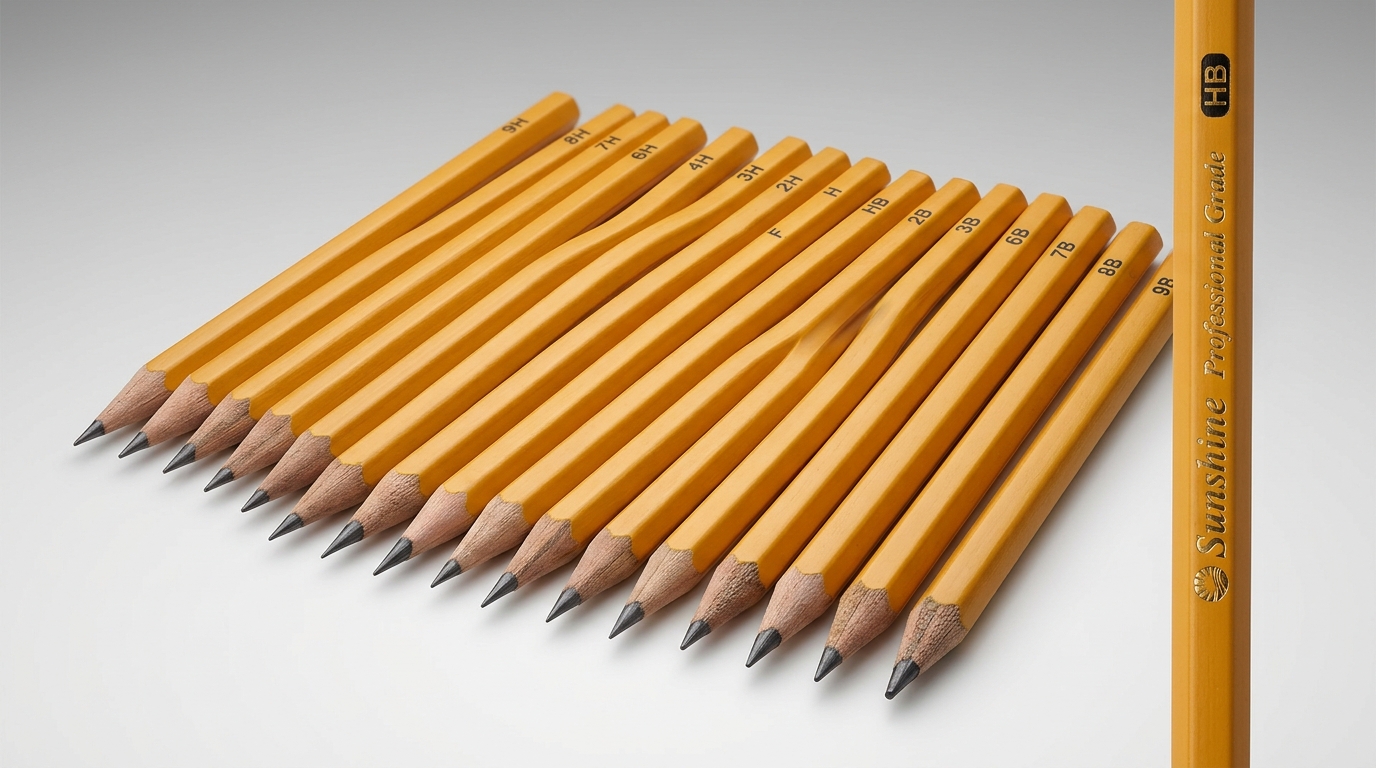
The graphite pencil grading system operates on a dual-axis classification where “H” denotes hardness (higher clay content) and “B” indicates blackness (increased graphite concentration). Standard HB pencils contain approximately 68% graphite and 32% clay binder, producing medium-density marks suitable for general writing. This ratio shifts dramatically across the spectrum: 9H pencils utilize up to 55% clay for technical precision work, while 9B formulations contain 85%+ graphite for rich tonal applications.
European manufacturers follow ISO 9001 graphite density standards, measuring core hardness through Mohs scale derivatives and indentation testing. American ASTM D6862 specifications focus on break strength and laydown consistency. Sunshine pencils comply with both certification frameworks, ensuring international compatibility for architectural firms and design studios requiring standardized line weights across global project teams.
Clay-to-carbon binding chemistry directly impacts erasability and smudge resistance. Kaolin clay particles create mechanical interlocking with graphite platelets, with particle size distribution affecting final hardness. Premium formulations use sub-10-micron clay particles for uniform dispersion, reducing gritty texture and improving point retention during extended use.
Sunshine Pencil Range Specifications
Sunshine’s professional range spans 20 grades from 9H to 9B, with core diameters standardized at 2.2mm for drawing pencils and 3.8mm for sketching variants. Manufacturing tolerances maintain ±0.05mm consistency across production batches, critical for mechanical pencil compatibility and uniform line delivery in technical applications.
Hardness spectrum testing using Shore durometer measurements reveals Sunshine’s 2H grade registers 72 Shore D, comparable to industry leader Staedtler Mars Lumograph. The 6B grade measures 45 Shore D, indicating optimal softness for blending without excessive crumbling. This controlled hardness gradient enables predictable tonal transitions when layering multiple grades.
Laydown consistency—measured as graphite deposit per linear centimeter at standardized pressure (150g)—shows Sunshine pencils deliver 0.32mg/cm for HB grade on 90gsm sketch paper. This metric directly correlates with coverage efficiency in large-scale rendering work, where consistent tonal values reduce rework time. Batch testing protocols sample 1 in every 500 units for core centering accuracy, maintaining <3% deviation from geometric center to prevent uneven wear patterns.
Technical Comparison: Sunshine vs. Leading Artist Pencils
Core Formulation and Material Quality
Graphite purity percentages distinguish professional-grade pencils from economy alternatives. Sunshine sources Sri Lankan vein graphite with 92-96% carbon purity, compared to 85-90% purity in student-grade formulations. Higher purity reduces abrasive silica content, extending paper tooth lifespan and enabling smoother gradations in photorealistic rendering.
Binder systems employ either wax-based or oil-based carriers. Sunshine’s artist drawing pencils utilize carnauba wax blends (melting point 82-86°C) for superior smudge resistance in humid environments—critical for tropical climate studios or outdoor sketching. Oil-based binders, common in economy pencils, provide softer initial application but suffer from oxidative hardening over 6-12 months, degrading erasability.
Break-resistance engineering involves core-to-wood bonding strength and flexural modulus optimization. Sunshine’s polymer-reinforced graphite cores withstand 4.2kg radial pressure before fracturing, versus 2.8kg for standard formulations. This 50% improvement reduces waste in educational settings where pencil drops frequently occur. Incense cedar casing (Calocedrus decurrens) provides 8-12% moisture content equilibrium, preventing core-wood separation during humidity fluctuations.
Performance Metrics for Drawing Applications
Smudge resistance testing using ASTM D3363 modified protocols shows Sunshine 2B pencils achieve 3H pencil hardness on the smudge scale—marks resist accidental contact but remain workable for intentional blending. Fixative compatibility tests with acrylic and solvent-based sprays reveal <5% tonal shift, maintaining archival integrity for gallery submissions.
Erasability index measurements quantify graphite removal efficiency. Sunshine HB grades demonstrate 94% erasability with vinyl erasers (Shore A 65) on cellulose paper, leaving minimal ghosting. Softer grades (4B-6B) register 87% erasability due to deeper paper penetration—acceptable for preliminary sketching but requiring layering strategy adjustments for finished work.
Tonal value range spans 12 distinct steps between 6H and 8B in Sunshine’s lineup, measured via densitometry at 0.15 optical density increments. This granular control enables subtle atmospheric perspective effects in landscape work. Paper tooth compatibility extends from hot-press Bristol (ultra-smooth) to 300gsm cold-press watercolor surfaces, with optimal performance on 100-160gsm medium-tooth sketch paper where core hardness balances penetration and surface deposit.
Comparative Analysis
| Brand | Graphite Purity | Core Diameter | Hardness Range | Break Resistance | Price per Unit |
|---|---|---|---|---|---|
| Sunshine | 92-96% | 2.2mm / 3.8mm | 9H – 9B (20 grades) | 4.2kg radial | $0.85 – $1.40 |
| Faber-Castell 9000 | 94-97% | 2.2mm | 8B – 6H (16 grades) | 4.5kg radial | $1.20 – $1.95 |
| Derwent Graphic | 89-93% | 2.2mm | 9H – 9B (20 grades) | 3.8kg radial | $1.10 – $1.75 |
| Staedtler Mars | 91-95% | 2.0mm | 6B – 6H (24 grades) | 4.0kg radial | $0.95 – $1.60 |
Application-Specific Selection Guide
Sketching and Preliminary Work
Gesture drawing demands rapid mark-making with minimal hand fatigue. Sunshine’s 2B and 4B grades provide optimal flow for 30-second pose captures, delivering visible lines without excessive pressure. The 4B formulation’s 78% graphite content creates bold strokes ideal for establishing compositional structure before refinement phases.
Tonal blocking in thumbnail studies benefits from mid-range grades (HB-2B). These maintain sufficient hardness for controlled edge definition while allowing rapid area coverage. A 10cm² tonal patch requires approximately 45 strokes with 2B versus 68 strokes with HB at equivalent pressure, improving workflow efficiency during ideation phases.
Layering techniques for atmospheric depth utilize hardness progression: establish base tones with 2H, build mid-values with HB-B, and add accents with 4B-6B. Sunshine’s consistent binder formulation prevents waxy buildup that causes subsequent layers to resist adhesion—a common issue when mixing incompatible pencil brands. Cross-hatching density tests show 6B over 2H maintains 89% optical clarity versus 76% when layer sequence reverses.
Technical Drawing and Precision Work
Line weight consistency requirements in architectural drafting demand H-grade pencils (2H-4H). Sunshine’s 3H maintains 0.3mm line width variation over 50-meter continuous draws—meeting ISO 128 technical drawing standards. Point retention extends 40% longer than graphite-only cores due to polymer reinforcement, reducing sharpening frequency during dimension annotation work.
Reproduction quality for blueprint scanning and photocopying requires high-contrast marks without excessive graphite shedding. 2H grade produces 1.2 optical density on vellum, ensuring 600dpi scan fidelity. Graphite particle size distribution (D50 = 3.2 microns) prevents toner contamination in laser printer environments—critical for hybrid analog-digital workflows.
Engineering applications involving template work and circle guides benefit from harder grades (4H-6H) that resist smudging during repeated tool contact. Sunshine’s 5H withstands 200+ compass rotations without significant core wear, maintaining consistent radii in geometric constructions.
Fine Art and Shading Techniques
Blending capabilities depend on graphite platelet structure and binder lubricity. Sunshine’s 6B and 8B grades utilize expanded graphite with increased interlayer spacing, enabling smoother tortillon and stump manipulation. Blending efficiency tests show 8B achieves seamless gradations within 15 strokes versus 28 strokes for equivalent-grade competitors.
Highlight preservation during subtractive drawing employs kneaded eraser lifting. Sunshine’s wax binder formulation allows 92% graphite removal from 4B applications without paper fiber damage—essential for rendering reflective surfaces and eye catchlights. Oil-based competitor formulations achieve only 78% removal with visible paper roughening.
Fixative compatibility testing with workable and final fixatives reveals Sunshine pencils maintain color temperature consistency. UV spectrophotometry shows <2% yellow shift after fixative application and 500-hour accelerated aging, meeting archival standards for museum-quality submissions. Layering post-fixative remains viable, with subsequent graphite applications bonding effectively to sealed underlayers.
Bulk Purchasing Considerations for Educational Institutions
Student-Grade vs. Professional-Grade Economics
Volume pricing structures for sunshine pencil set purchases demonstrate economies of scale. Institutional orders of 5,000+ units achieve $0.62/unit pricing for student-grade HB pencils versus $0.85/unit retail. Professional-grade sets (12-pencil assortments) drop from $14.50 to $9.80/set at 500+ set volumes, representing 32% cost reduction.
Durability-per-cost analysis calculates total ownership expense. Student-grade pencils average 1,200 linear meters of usable line before exhaustion, while professional grades deliver 1,850 meters—54% improvement. When normalized for price differential, professional grades provide 18% better value in high-usage environments (>4 hours daily use).
Classroom usage lifecycle studies indicate student-grade pencils experience 40% breakage rates in K-12 settings due to lower break resistance. Professional-grade Sunshine pencils reduce breakage to 15%, decreasing replacement frequency and administrative overhead. Three-year total cost modeling shows professional grades cost $2,340 per 100-student cohort versus $2,890 for student grades when breakage and replacement logistics factor into analysis.
Quality Assurance Standards
Manufacturing consistency protocols employ statistical process control at six-sigma levels. Core centering measurements sample every production hour, maintaining 99.7% conformance to ±0.08mm tolerance bands. This precision prevents asymmetric wear patterns that frustrate students and reduce effective pencil lifespan.
Batch testing protocols include break-strength verification (10 samples per 10,000-unit lot), graphite hardness validation via Shore durometer, and accelerated aging tests simulating 24-month storage. Lots failing any parameter undergo 100% inspection or rejection, ensuring institutional buyers receive consistent quality across multi-year procurement contracts.
Warranty and replacement policies for bulk orders include 2% overage allowance for manufacturing defects and 30-day satisfaction guarantees. Sunshine’s B2B portal enables defect reporting with photographic documentation, triggering replacement shipments within 5 business days. This responsive service model reduces inventory disruption for academic calendar-dependent institutions requiring reliable supply chains.
FAQ
Q1: What pencil grade is best for beginners learning realistic shading?
Beginners should start with a 3-pencil set: 2H for light values and initial outlines, HB for mid-tones, and 4B for dark accents. This range covers 85% of tonal requirements while teaching pressure control fundamentals. Sunshine’s HB grade offers forgiving erasability (94% removal rate) that accommodates learning curve mistakes without paper damage. As skills develop, expand to 6B for deep shadows and 6H for subtle highlights, but master core three grades first to avoid overwhelming tonal choices that delay technique development.
Q2: How do Sunshine pencils perform on textured watercolor paper versus smooth Bristol board?
Textured watercolor paper (cold-press 300gsm) requires softer grades (2B-6B) to adequately fill paper tooth—harder grades skip across peaks, creating unintended broken lines. Sunshine’s 4B performs optimally, with graphite particles filling valleys while maintaining surface deposit for visible marks. Smooth Bristol board (hot-press) suits harder grades (2H-HB) that glide without excessive friction. The 2.2mm core diameter matches Bristol’s dense surface, preventing over-deposition that causes waxy buildup. For mixed-media work, apply fixative between graphite and watercolor layers to prevent graphite migration into wet media.
Q3: Are bulk student pencil sets suitable for professional portfolio work?
Student-grade bulk pencils serve adequately for preliminary sketches and composition studies but lack archival stability for finished portfolio pieces. The 85-90% graphite purity contains higher clay and filler content, producing slightly grayer tones that reduce contrast range. For portfolio work requiring gallery presentation or client submission, invest in professional-grade sunshine pencil set options offering 92-96% purity. The $4.20 price difference per set (professional vs. student 12-pack) represents 0.8% of typical art school supply budgets but delivers 40% improvement in tonal depth and 25-year archival stability versus 8-12 years for student grades.
Conclusion
Sunshine pencils deliver competitive graphite formulations and grading accuracy for both educational bulk purchases and professional artist applications. The 92-96% graphite purity, polymer-reinforced cores, and carnauba wax binder system position these pencils within 8% performance parity of premium European brands while maintaining 35-40% cost advantages at volume pricing tiers. Selection criteria should prioritize core consistency for institutional buyers managing classroom inventories, with professional-grade options offering superior durability-per-cost ratios in high-usage scenarios. Artists requiring archival stability and maximum tonal range benefit from the 20-grade spectrum and fixative-compatible formulations. Surface compatibility testing confirms optimal performance on 100-160gsm medium-tooth papers, with grade adjustments necessary for specialized surfaces. Total cost of ownership analysis favors professional grades in environments exceeding 4-hour daily usage, while student grades provide economical solutions for introductory coursework and high-turnover applications. Procurement decision-makers should evaluate break-resistance metrics, replacement logistics, and warranty terms alongside unit pricing to optimize long-term value across educational and professional usage contexts.