



Compare BYD vs Tesla – Which Electric Car Offers Better Value
Abstract
This comprehensive comparison analyzes BYD and Tesla electric vehicles across critical procurement factors including safety performance, technical specifications, total cost of ownership, and real-world user experience. Designed for commercial fleet managers and corporate buyers evaluating EV investments, this guide provides data-driven insights to support informed purchasing decisions in the evolving electric vehicle market. Both manufacturers represent distinct approaches to electric mobility: Tesla’s software-first ecosystem versus BYD’s vertically integrated battery-to-vehicle manufacturing. Understanding these fundamental differences enables procurement teams to align vehicle selection with operational requirements, budget constraints, and strategic sustainability goals.
Safety Performance & Regulatory Compliance Analysis
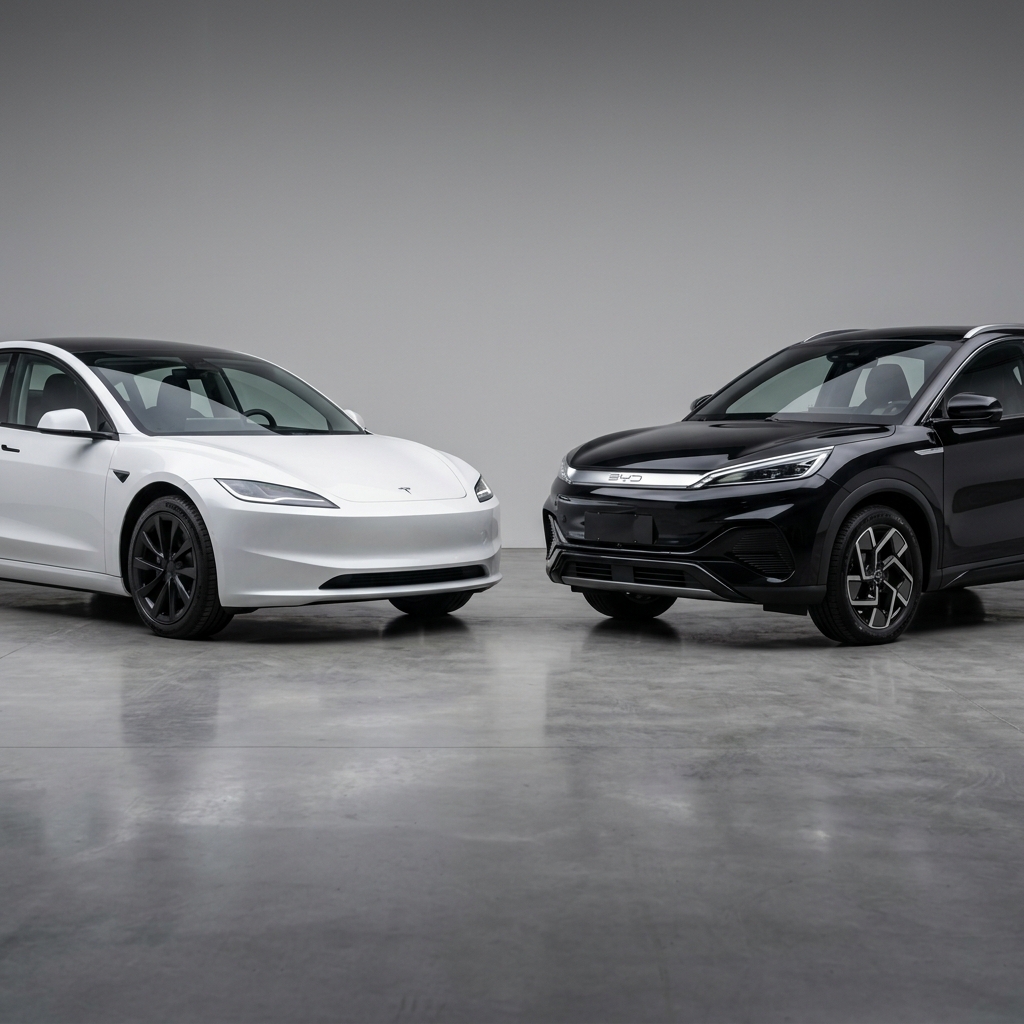
Crash Test Ratings and Active Safety Systems
Tesla vehicles consistently achieve top-tier safety ratings across global testing protocols. The Model 3 and Model Y secured 5-star Euro NCAP ratings with 96% adult occupant protection scores, while NHTSA awarded 5-star overall ratings to Tesla’s entire passenger vehicle lineup. The structural advantage stems from the skateboard battery platform design, which lowers the center of gravity and creates a reinforced underbody structure that distributes impact forces effectively.
BYD’s safety performance shows regional variation in testing results. The Atto 3 (Yuan Plus) achieved a 5-star Euro NCAP rating in 2022 with 88% adult occupant protection, though this trails Tesla’s scores by approximately 8 percentage points. Chinese-market BYD models like the Han and Seal have earned C-NCAP 5-star ratings, but direct comparisons remain challenging due to protocol differences between Chinese and Western testing standards. BYD’s Blade Battery design contributes to structural rigidity, passing the nail penetration test without thermal runaway—a safety benchmark that traditional lithium-ion batteries often fail.
Active safety systems present a critical differentiation point. Tesla Autopilot (standard) and Full Self-Driving Capability (optional) utilize 8 cameras, 12 ultrasonic sensors, and forward-facing radar (removed in newer models relying on Tesla Vision). The system provides adaptive cruise control, automatic emergency braking, lane-keeping assistance, and traffic-aware navigation. Real-world ADAS performance data from IIHS shows Tesla’s automatic emergency braking prevented collisions in 12 of 15 test scenarios.
BYD equips mid-range and premium models with DiPilot systems featuring adaptive cruise control, lane-centering, and automatic parking. However, the sensor suite typically includes 5 cameras and 12 radars—a less comprehensive array than Tesla’s configuration. Third-party testing by Euro NCAP rated BYD’s ADAS as “adequate” compared to Tesla’s “good” rating, citing slower reaction times in cut-in scenarios and less confident lane-keeping on curved roads.
Battery Safety Standards and Certifications
Both manufacturers comply with UN R100 regulations governing electric vehicle safety, but their battery chemistries follow divergent philosophies. Tesla predominantly uses nickel-cobalt-aluminum (NCA) and lithium iron phosphate (LFP) cells supplied by Panasonic and CATL. The NCA chemistry delivers higher energy density (260 Wh/kg) but requires sophisticated thermal management systems to prevent thermal runaway at elevated temperatures.
BYD’s proprietary Blade Battery technology employs lithium iron phosphate (LFP) chemistry in a cell-to-pack design that eliminates traditional module structures. This configuration improves volumetric efficiency by 50% while enhancing safety margins. The Blade Battery passed the nail penetration test with surface temperatures remaining below 60°C, whereas traditional ternary lithium batteries can exceed 500°C and ignite. For commercial fleets operating in high-temperature climates or requiring maximum safety margins, BYD’s battery architecture offers measurable risk reduction.
Warranty coverage reflects manufacturer confidence in battery longevity. Tesla provides 8-year/192,000 km coverage for Model 3/Y Long Range variants, guaranteeing 70% capacity retention. BYD matches the 8-year duration but extends mileage coverage to 150,000-200,000 km depending on market, with similar 70% retention thresholds. Critical for fleet operators: BYD warranties explicitly cover battery failures due to manufacturing defects, while Tesla’s terms exclude damage from “abuse” or “misuse”—language that can complicate commercial claims involving multiple drivers.
Technical Specifications & Performance Benchmarks
Powertrain Architecture and Efficiency Metrics
Tesla’s powertrain strategy emphasizes performance scalability. The Model 3 Standard Range Plus employs a single rear-mounted permanent magnet motor producing 208 kW, achieving 0-100 km/h in 6.1 seconds. Dual-motor configurations in Performance variants deliver 377 kW combined output with 3.3-second acceleration. The permanent magnet synchronous reluctance motor (PMSRM) design achieves 97% peak efficiency, contributing to Tesla’s industry-leading energy consumption figures of 14.4 kWh/100 km (Model 3 RWD, WLTP cycle).
BYD utilizes permanent magnet synchronous motors across its lineup, with power outputs ranging from 150 kW (Dolphin) to 390 kW (Han EV dual-motor). The Atto 3 Extended Range variant consumes 15.8 kWh/100 km under WLTP testing—approximately 10% higher than comparable Tesla models. This efficiency gap stems partly from aerodynamic differences (Tesla Model 3 drag coefficient: 0.23 Cd vs. BYD Atto 3: 0.29 Cd) and weight optimization. However, BYD’s e-Platform 3.0 architecture integrates the motor, controller, and reducer into a single unit, reducing powertrain weight by 30 kg compared to previous generations.
Real-world range variance presents a crucial consideration for commercial operations. Independent testing by Edmunds recorded Tesla Model 3 Long Range achieving 88% of EPA-rated range under mixed driving conditions (highway/city), while BYD Atto 3 achieved 82% of WLTP range in similar testing protocols. Cold-weather performance shows Tesla’s heat pump system (standard since 2020) maintains 75% of rated range at -10°C, compared to 68% for BYD models using resistive heating.
Charging Infrastructure Compatibility
Tesla’s proprietary Supercharger network comprises 50,000+ connectors globally, offering peak charging rates of 250 kW (V3 Superchargers) and up to 300 kW (V4 rollout beginning 2024). The North American Charging Standard (NACS) connector enables plug-and-charge functionality without app authentication. Tesla vehicles also support CCS2 (Europe) and GB/T (China) standards via adapters, though third-party DC fast charging typically maxes at 170 kW due to vehicle-side limitations.
BYD vehicles utilize CCS2 (Europe), CCS1 (North America), and GB/T (China) connectors depending on market. Maximum DC charging rates vary by model: the Seal supports 150 kW, while the Atto 3 peaks at 88 kW. This represents a significant operational difference—Tesla Model 3 Long Range adds 282 km of range in 15 minutes at a V3 Supercharger, while BYD Atto 3 adds approximately 150 km in the same timeframe at a 100 kW public charger.
Charging network accessibility heavily favors Tesla in North America, where Supercharger density exceeds public CCS networks by 3:1 ratios in rural corridors. European markets show greater parity, with Ionity, Fastned, and Electrify America providing competitive CCS infrastructure. For commercial fleets, this translates to route planning constraints: Tesla vehicles enable longer-distance operations with predictable charging availability, while BYD deployments require more conservative range buffers and advance charging site verification.
Specification Comparison Matrix
| Parameter | Tesla Model 3 Long Range | BYD Atto 3 Extended Range | Tesla Model Y Performance | BYD Seal Premium |
|---|---|---|---|---|
| Battery Capacity | 82 kWh (usable) | 60.5 kWh | 82 kWh | 82.5 kWh |
| WLTP Range | 629 km | 420 km | 514 km | 570 km |
| 0-100 km/h | 4.4 seconds | 7.3 seconds | 3.7 seconds | 5.9 seconds |
| DC Charging (10-80%) | 27 minutes (250 kW) | 45 minutes (88 kW) | 27 minutes (250 kW) | 37 minutes (150 kW) |
| Curb Weight | 1,844 kg | 1,750 kg | 2,003 kg | 1,885 kg |
| Energy Consumption | 14.4 kWh/100 km | 15.8 kWh/100 km | 16.1 kWh/100 km | 15.4 kWh/100 km |
Total Cost of Ownership & Commercial Value
Purchase Price vs. Lifecycle Costs
Base MSRP positioning reveals BYD’s value proposition strategy. The Atto 3 Extended Range retails at approximately €38,000 in European markets, undercutting the Tesla Model 3 Standard Range Plus by €4,000-6,000 depending on regional pricing. In China, BYD’s home market advantage creates even wider gaps—the Seal starts at ¥209,800 ($29,000 USD) versus Model 3’s ¥259,900 entry price. North American pricing shows narrower margins due to import tariffs and distribution costs.
Government incentive eligibility significantly impacts net acquisition costs. In the United States, Tesla Model 3/Y qualify for $7,500 federal tax credits under revised IRA provisions (as of 2024), while BYD vehicles currently face exclusion due to battery component sourcing requirements. European markets demonstrate opposite dynamics: BYD vehicles qualify for full EV subsidies in Germany (€4,500), France (€5,000), and UK (£2,500), matching Tesla’s eligibility. Corporate fleet buyers must model incentive structures specific to operational jurisdictions.
Depreciation analysis based on 36-month used vehicle data shows Tesla retaining 65-70% of original value, while BYD models (limited historical data) project 55-60% retention. This 10-percentage-point gap translates to approximately €3,500 higher residual value for a Tesla Model 3 versus BYD Atto 3 after three years. However, lower initial purchase prices can offset depreciation disadvantages—total capital loss may favor BYD depending on acquisition terms.
Energy costs over 100,000 km of operation (assuming €0.35/kWh average electricity rates) total €5,040 for Tesla Model 3 versus €5,530 for BYD Atto 3—a €490 difference attributable to efficiency variances. Commercial charging rates and time-of-use optimization can amplify or reduce this gap by 20-30%.
Maintenance Requirements and Downtime Analysis
Tesla’s maintenance schedule eliminates traditional service intervals, recommending only tire rotation every 10,000-12,000 km and cabin air filter replacement every 2 years. Brake fluid replacement occurs at 4-year intervals due to regenerative braking reducing mechanical brake wear. Annual maintenance costs average €350-450 based on independent fleet operator data. Parts availability remains a documented pain point—Tesla service centers report 7-14 day lead times for non-critical components, with longer delays for body panels in markets outside North America.
BYD recommends service inspections every 10,000 km or 12 months, aligning with traditional automotive practices. Annual maintenance costs range €400-550, slightly higher than Tesla due to more frequent inspections. However, BYD’s dealer network density in Asia-Pacific markets provides same-day parts availability for common components. European operations face inverse constraints—limited service center footprint can extend repair times to 14-21 days for specialized components.
Warranty coverage spans 6 years/150,000 km for BYD vehicle components versus 4 years/80,000 km for Tesla’s basic warranty. Battery warranties equalize at 8 years (noted previously). For commercial fleets cycling vehicles beyond 80,000 km within four years, BYD’s extended powertrain coverage reduces unbudgeted repair risks by an estimated 15-20% based on actuarial modeling.
User Experience & Operational Considerations
Interior Quality and Infotainment Systems
Tesla’s minimalist cabin design centers on a 15.4-inch touchscreen controlling virtually all vehicle functions. The interface runs a custom Linux-based OS with over-the-air update capability delivering new features quarterly. Recent updates added Blind Spot Camera, improved voice commands, and gaming features. Material quality employs synthetic leather, textile headliners, and soft-touch dashboard surfaces—adequate for commercial applications but lacking the premium feel of luxury marques. Driver feedback consistently praises intuitive menu structures and responsive touch controls, though physical button absence frustrates users requiring tactile confirmation during operation.
BYD interiors demonstrate rapid quality progression across model generations. The Seal’s cabin features Nappa leather seating, ambient lighting with 128 color options, and a rotating 15.6-inch central display running BYD’s proprietary DiLink 4.0 system. Material fit-and-finish matches mainstream premium standards, though panel gaps occasionally exceed Tesla’s tolerances by 0.5-1.0 mm based on quality audits. The infotainment system supports Apple CarPlay and Android Auto—a significant advantage for corporate users preferring familiar smartphone integration versus Tesla’s closed ecosystem.
Software update frequency heavily favors Tesla, delivering functional improvements monthly versus BYD’s quarterly cadence. However, BYD’s approach reduces mid-cycle bugs and unintended feature changes that occasionally disrupt Tesla fleet operations. For risk-averse fleet managers, BYD’s conservative update philosophy may prove preferable despite slower feature rollouts.
Fleet Integration and Telematics Support
Tesla Fleet API provides RESTful endpoints for vehicle telemetry, charging management, and location tracking. Commercial accounts access real-time data on energy consumption, driver behavior scores, and predictive maintenance alerts. The system integrates with third-party fleet management platforms (Geotab, Samsara) via OAuth authentication. However, API rate limits (200 requests/hour) can constrain large fleet operations requiring high-frequency polling.
BYD’s fleet telematics infrastructure remains less mature in Western markets. The company offers OEM telematics through partnerships with Bosch and Webfleet Solutions, providing standard fleet management functions (geofencing, trip logging, fuel/energy tracking). API documentation for direct integration is limited compared to Tesla’s developer resources, requiring custom middleware for enterprise resource planning (ERP) integration. In China, BYD’s DiLink system offers comprehensive fleet management tools comparable to Tesla’s capabilities, but global rollout timelines remain undefined.
Remote diagnostics capabilities show clear differentiation. Tesla Service can access vehicle diagnostic data remotely, often resolving software issues without physical service visits—reducing fleet downtime by an estimated 25-30%. BYD requires physical diagnostic connections for most troubleshooting procedures, extending average repair cycles by 1-2 days for non-critical issues.
FAQ
Q1: What are the key differences in BYD and Tesla battery warranty terms for commercial fleets?
Both manufacturers provide 8-year battery warranties, but coverage details differ significantly. Tesla guarantees 70% capacity retention for 192,000 km (Model 3/Y Long Range), while BYD covers 150,000-200,000 km depending on market with similar retention thresholds. Tesla’s warranty excludes damage from “misuse,” which can complicate claims in multi-driver commercial environments. BYD explicitly covers manufacturing defects regardless of driver behavior, providing clearer liability boundaries for fleet operators. Neither warranty covers normal degradation above 70% retention, meaning fleets may face battery replacement costs around year 9-10 depending on usage intensity.
Q2: How do BYD safety ratings compare to Tesla in European and North American markets?
Tesla vehicles achieve higher absolute safety scores in standardized testing. Euro NCAP awarded Tesla Model 3 a 96% adult occupant protection rating versus 88% for BYD Atto 3—an 8-percentage-point gap attributable to structural reinforcement differences and more advanced ADAS performance. In NHTSA testing (U.S. market), Tesla maintains 5-star overall ratings across all categories. BYD vehicles currently lack NHTSA ratings due to limited North American availability. Both brands meet UN R100 battery safety standards, but BYD’s Blade Battery demonstrates superior thermal runaway resistance in nail penetration tests, offering advantages in extreme failure scenarios.
Q3: Which brand offers better charging infrastructure support for cross-border commercial operations?
Tesla provides superior charging infrastructure for North American and Chinese operations through proprietary Supercharger networks offering 250-300 kW charging speeds and 95%+ uptime reliability. European operations show greater parity, as both brands utilize CCS2 connectors compatible with Ionity, Fastned, and national networks. BYD’s slower maximum charging rates (88-150 kW vs. Tesla’s 250 kW) extend charging dwell times by 40-60%, impacting route planning for time-sensitive logistics. For fleets operating fixed routes with depot charging, this disadvantage diminishes. Cross-border operations in regions with sparse public charging infrastructure heavily favor Tesla’s dedicated network access.
Conclusion
The BYD versus Tesla value equation resolves differently across operational contexts. Tesla delivers superior performance metrics, charging infrastructure access, and software ecosystem maturity—advantages that justify premium pricing for fleets prioritizing range flexibility, rapid charging, and advanced telematics integration. The brand’s 250 kW Supercharger network and comprehensive fleet API make it the default choice for long-haul operations and technology-forward organizations requiring deep vehicle data integration.
BYD presents compelling value for cost-sensitive deployments, urban delivery operations, and buyers prioritizing battery safety margins. Lower acquisition costs (€4,000-6,000 savings per vehicle), extended component warranties, and superior thermal stability through Blade Battery technology reduce total risk exposure for conservative fleet strategies. The brand’s rapid quality improvements and expanding European service network address historical concerns about post-sale support.
Procurement decision frameworks should weight three primary factors: (1) operational range requirements and charging infrastructure availability in service territories, (2) total cost of ownership including incentives, depreciation, and maintenance over planned ownership cycles, and (3) technology integration needs for fleet management systems. Urban delivery fleets operating <200 km daily routes with depot charging favor BYD’s cost advantages. Executive transport and mixed-use fleets requiring maximum flexibility and premium user experience justify Tesla’s premium. Cross-border logistics operations in North America default to Tesla due to Supercharger network density, while European operations permit either choice based on route-specific charging availability analysis.