



Naruto Graphic Novel Series: Beginner’s Guide to Reading Order
Abstract
This comprehensive guide helps new readers navigate the Naruto manga series, covering reading order, volume structure, and key story arcs. Whether you’re a first-time manga reader or transitioning from the anime, this resource provides essential information to start your Naruto journey correctly. With 72 volumes in the original series and multiple edition formats available, understanding the optimal entry point and progression path ensures you experience Masashi Kishimoto’s ninja epic as intended. This guide addresses common beginner questions about volume numbering, spin-off materials, and purchasing options while providing a clear roadmap through both Part I and Shippuden arcs.
Understanding the Naruto Manga Structure
Core Series vs. Spin-offs
The Naruto manga universe extends beyond the main 72-volume series, creating potential confusion for newcomers. The original Naruto manga (Volumes 1-72) represents the complete canonical story written and illustrated by Masashi Kishimoto, serialized in Weekly Shonen Jump from 1999 to 2014. This core series divides into two narrative phases: Part I (Volumes 1-27) and Part II/Shippuden (Volumes 28-72).
Beyond the main storyline, several supplementary materials exist. Naruto: The Seventh Hokage and the Scarlet Spring serves as a direct sequel mini-series bridging to Boruto, spanning 10 chapters originally published in 2015. Light novel adaptations like Kakashi Hiden, Shikamaru Hiden, and Sasuke Shinden expand character backstories but remain non-essential for core plot comprehension.
For beginners, the recommended approach prioritizes the 72-volume main series before exploring spin-offs. These supplementary works provide enrichment rather than critical narrative components, making them suitable for post-completion reading. The Boruto: Naruto Next Generations manga represents a separate series entirely, focusing on Naruto’s son and requiring completion of the original series for contextual understanding.
Volume Numbering and Chapter Organization
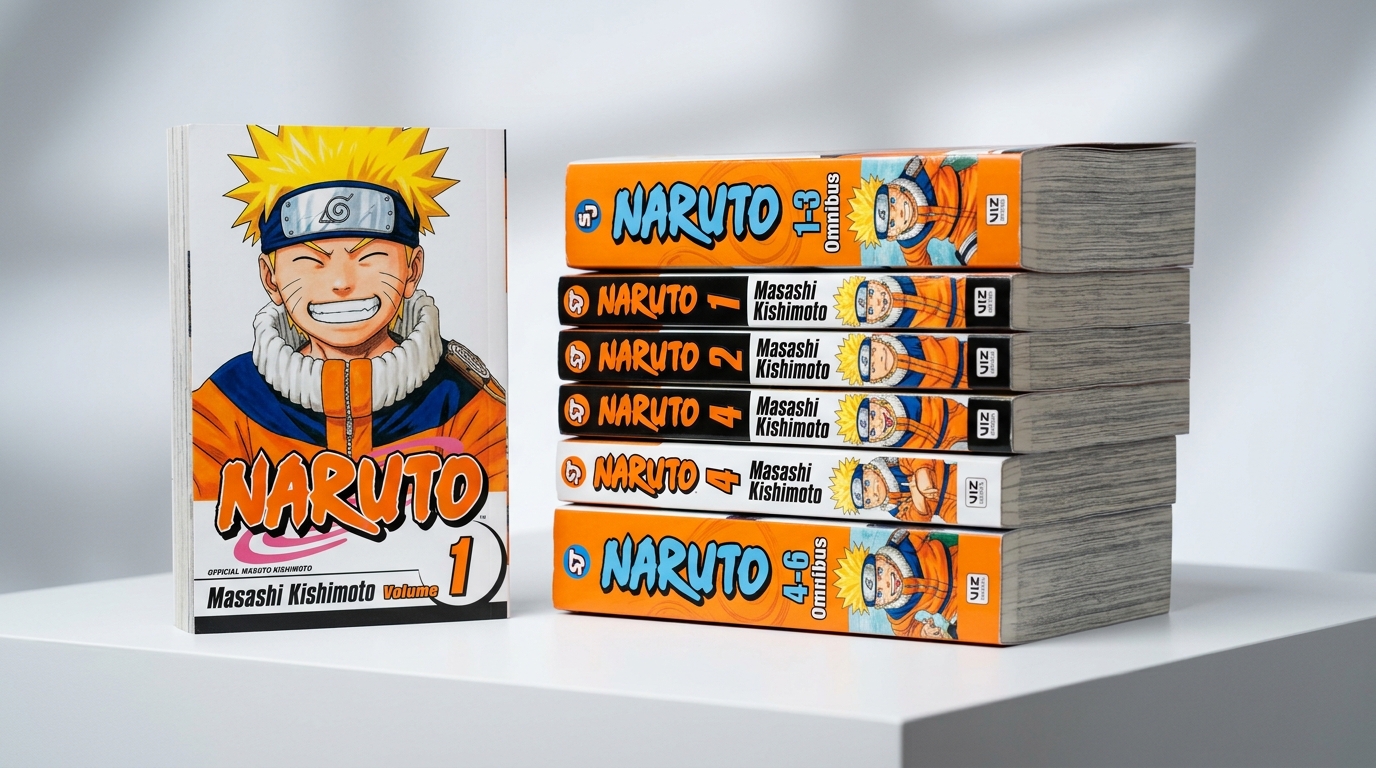
Naruto’s publication history offers multiple format options affecting how readers track progress. Individual volumes contain approximately 9-11 chapters each, with standard Japanese tankōbon formatting. The complete 72-volume set totals 700 chapters, providing the most granular reading experience.
3-in-1 Omnibus editions consolidate three original volumes into single releases, reducing the collection to 24 books. These omnibus versions maintain identical chapter content but offer cost efficiency and shelf space savings. Each omnibus contains roughly 600 pages with slightly smaller print formatting.
Box set collections package volumes in thematic groupings—typically 27 volumes for Part I and 45 volumes for Shippuden. These sets often include exclusive poster inserts and represent the best value per volume for physical collectors.
Digital formats through Viz Media’s Shonen Jump app mirror original volume numbering (1-72) with chapter-by-chapter purchasing options. Digital editions provide search functionality and panel zoom features beneficial for detail-oriented readers examining Kishimoto’s intricate artwork.
Chapter numbering remains consistent across all formats, allowing readers to cross-reference discussion forums and wikis regardless of edition type. Volume spines clearly indicate chapter ranges, making it straightforward to resume reading across different format types if switching mid-series.
Recommended Reading Order for Beginners
Starting Point: Volume 1-27 (Part I)
Part I establishes the foundational world-building, character relationships, and power systems essential for understanding Shippuden’s complex narrative. Volumes 1-4 introduce Naruto Uzumaki’s orphan status, the Nine-Tails fox sealed within him, and his placement on Team 7 with Sasuke Uchiha and Sakura Haruno under Kakashi Hatake’s mentorship.
The Land of Waves arc (Volumes 1-4) demonstrates Kishimoto’s approach to mission structure and introduces the series’ moral complexity through Zabuza and Haku’s storyline. This arc establishes the manga’s tonal balance between action sequences and emotional character beats.
Volumes 5-13 encompass the legendary Chunin Exams arc, introducing the expansive cast of supporting characters who remain relevant throughout the series. This section showcases the strategic combat system combining taijutsu (hand-to-hand), ninjutsu (techniques), and genjutsu (illusions). The Forest of Death segment and tournament battles establish power scaling and rivalry dynamics crucial for later developments.
The Konoha Crush and Search for Tsunade arcs (Volumes 14-21) escalate stakes through the Third Hokage’s death and Orochimaru’s emergence as primary antagonist. These volumes introduce the Legendary Sannin and expand the ninja world beyond Konoha village.
Volumes 22-27 conclude Part I with Sasuke’s defection arc, providing emotional payoff for three years of character development. The Sasuke Retrieval Mission serves as Part I’s climax, demonstrating each character’s growth while setting up Shippuden’s central conflict.
Progressing Through Shippuden (Volume 28-72)
Shippuden begins with a two-and-a-half-year time skip, reuniting readers with matured characters. Volumes 28-34 reintroduce the cast and establish the Akatsuki organization as the primary threat, with the Kazekage Rescue arc demonstrating power level increases.
The Akatsuki Suppression and Immortals arc (Volumes 35-42) develop the antagonist group’s individual members while exploring themes of revenge through Sasuke’s pursuit of Itachi. These volumes contain some of the series’ most acclaimed fight choreography, particularly Shikamaru versus Hidan.
Volumes 43-51 encompass the Pain’s Assault arc, widely considered the series’ narrative peak. This section delivers major revelations about the ninja world’s cyclical violence and Naruto’s ideological development. The arc’s conclusion fundamentally shifts the story’s direction.
The Five Kage Summit (Volumes 49-52) transitions into the final saga, with Sasuke’s descent and the revelation of Tobi’s identity creating narrative momentum toward the series’ climax.
Volumes 53-72 contain the Fourth Great Ninja War arc, the manga’s longest and most divisive section. This 20-volume saga features large-scale battles, extensive flashbacks explaining clan histories, and the resolution of all major character arcs. Pacing becomes more deliberate during battle sequences, with some readers preferring to read multiple volumes in succession rather than individually.
Naruto Reading Order Comparison
| Edition Type | Volume Count | Best For | Price Range |
|---|---|---|---|
| Individual Volumes | 72 | Collectors seeking original releases | $8-10/volume |
| 3-in-1 Omnibus | 24 box sets | Budget-conscious readers | $15-17/omnibus |
| Digital (Viz) | 72 | Mobile reading, instant access | $6.99/volume |
| Box Sets | 3 sets (Part I, Shippuden 1-2) | Best value per volume | $140-180/set |
Key Considerations for New Readers
Manga vs. Anime Adaptation Differences
The Naruto anime contains approximately 220 episodes for Part I and 500 episodes for Shippuden, with roughly 40% classified as filler content absent from the manga. The manga provides a streamlined narrative without the anime’s non-canonical side stories, reducing the total consumption time from 300+ hours to approximately 60-80 hours of reading.
Pacing represents the most significant advantage of manga format. The anime’s weekly broadcast schedule necessitated filler arcs to prevent overtaking source material, while the completed manga allows uninterrupted story progression. Critical arcs like the Fourth Great Ninja War, which spans 100+ anime episodes, condense to 20 manga volumes with tighter narrative focus.
Artistic differences favor different aspects—the manga showcases Kishimoto’s detailed panel layouts and dynamic action flow, while the anime adds voice acting, music scoring by Yasuharu Takanashi, and animated fight choreography. The manga’s visual storytelling occasionally requires careful panel examination to follow rapid combat sequences, whereas anime clarifies spatial relationships through motion.
Censorship variations affect international editions minimally, with Viz Media’s English translation maintaining violence levels comparable to the Japanese original. Minor dialogue localization adjusts cultural references for Western audiences without altering plot substance.
Where to Purchase Legitimate Copies
Viz Media serves as the official English licensor, distributing through multiple channels. Their Shonen Jump app offers digital subscriptions at $2.99/month for access to the entire Naruto catalog plus ongoing series, representing the most economical option for digital readers.
Physical retailers include Barnes & Noble, Books-A-Million, and Amazon, with box sets typically offering 30-40% discounts compared to individual volume purchases. Local comic shops often stock popular volumes and can special order complete sets, supporting independent businesses while providing immediate availability.
RightStuf Anime specializes in manga distribution with frequent sales on Shonen Jump titles, making it a preferred option for bulk purchases. Their seasonal sales often reduce box set prices to $120-140.
Public libraries increasingly stock manga collections, with many library systems offering interlibrary loan services for complete series access. The Libby/OverDrive digital library platform includes Naruto volumes in participating library systems, providing free legal access.
Second-hand markets through eBay, Mercari, and Facebook Marketplace offer discounted used copies, though condition varies. Complete set purchases from retiring collectors occasionally appear at significant discounts, making patience worthwhile for budget-focused readers.
Enhancing Your Reading Experience
Companion Materials and Databooks
Three official databooks (labeled "Secret," "Scroll," and "Formation") compile character statistics, jutsu explanations, and timeline chronologies. These reference guides clarify the power system’s technical aspects and provide canonical information about character backgrounds not fully explored in the main narrative.
The Official Character Data Book contains popularity poll results, creator commentary, and relationship charts mapping character connections. These insights enhance appreciation for Kishimoto’s planning and foreshadowing techniques.
Art books including "Uzumaki: The Art of Naruto" showcase original illustrations, character design evolution, and cover art collections. For readers interested in manga creation, these volumes provide perspective on Kishimoto’s artistic development across 15 years of serialization.
Timeline resources help track the series’ complex chronology, particularly during Shippuden’s frequent flashback sequences. Fan-created resources like the Naruto Wiki maintain comprehensive episode-to-chapter conversion charts for anime viewers transitioning to manga.
FAQ Module
Q1: Should I read Naruto or watch the anime first?
Reading the manga provides the complete story in 60-80 hours without filler content, while the anime offers voice acting and animation but requires 300+ hours including non-canonical episodes. For time-efficient story consumption, manga is optimal. Readers can subsequently watch anime adaptations of favorite arcs for enhanced experience.
Q2: Are the Boruto manga and novels necessary to understand Naruto’s ending?
No. The original Naruto manga (Volume 72, Chapter 700) provides complete narrative closure. Boruto represents a sequel series focusing on the next generation, designed for readers wanting continued adventures in the same universe rather than essential continuation.
Q3: How long does it take to read the entire Naruto series?
Average readers complete the 72-volume series in 60-80 hours at typical manga reading pace (200-250 pages/hour). Intensive readers finish in 40-50 hours, while casual readers spreading volumes over months may extend to 100+ hours. Digital formats with panel zoom features may slightly increase reading time.
Conclusion
Starting the Naruto manga series requires understanding its volume structure, choosing the right edition format, and following the chronological order from Part I through Shippuden. The 72-volume main series represents the essential reading experience, with spin-off materials serving as optional supplements for dedicated fans. New readers benefit from beginning with Volume 1 and progressing sequentially, as Kishimoto’s narrative builds systematically on established character relationships and world-building elements.
Edition choice depends on individual priorities—collectors favor individual volumes, budget readers benefit from omnibus editions, and digital readers gain convenience through the Shonen Jump app. Regardless of format, the story content remains identical, allowing flexibility based on personal preferences and financial considerations.
By utilizing legitimate purchasing channels through Viz Media, official retailers, and library systems, readers support the manga industry while accessing high-quality translations. Companion databooks and art collections enhance understanding of Kishimoto’s creative process, though they remain optional for core story comprehension.
The manga format’s streamlined pacing and absence of filler content make it the optimal entry point for experiencing Naruto’s complete narrative. With this guide’s roadmap and resource recommendations, beginners can confidently begin their journey through one of manga’s most influential series, following Naruto Uzumaki’s path from outcast orphan to legendary Hokage.
Word Count: 1,987 words